


Interdisciplinary Endeavor
We represent this treatise as an "Interdisciplinary" scientific endeavor. The reader is implored to consider the hypothetical solutions presented here within the context of the specific scientific field that relate to the evidence. We are aware that the hypothesis demands new considerations related to cosmic impacts.
Carl Sagan noted
The truth may be puzzling. It may take some work to grapple with. It may be counterintuitive. It may contradict deeply held prejudices. It may not be consonant with what we desperately want to be true. But our preferences do not determine what's true.... Cleverly designed experiments are the key. (Sagan, 1995).
We present our Bearing Calculator as a very cleverly designed experiment.An obvious question is "Why has no one noticed all this overlain ejecta, and the 'power washed' landscape across the Saginaw area?" In the August 2003 issue of Physics Today, Spencer Weart discussed the topic of The Discovery of Rapid Climate Change. He makes a case for why the sudden shifts in climate - now documented - were overlooked for so long. Researchers had no expectation, so they did not look at the data in a granularity that would show the behavior. Instead, a gradual evolution is seen, where researchers expected significant change required eons but found millennia change, and when they looked for the millennia details they found changes within centuries. Only after looking for century-resolution data did they note the near-instantaneous changes.
This is the great vice of academicism, that it is concerned with ideas rather than with thinking. - Lionel Trilling
My goal is to spark interest in this theory among members of various professions, yet in some cases, that spark has occasionally been extinguished by members of the scientific community. A collaborator has put the situation into a concise paragraph:
We must value diversity. That is what saves us as a species. I'm sure it has in the past, and I'm sure it will in the future. Anyone with a real scientific sense of our environment, terrestrial or otherwise, understands this basic truth at an intuitive level, even if they have learned later in life to rationalize some denial of the concept for whatever the unfortunate reason. Truly unfortunate.
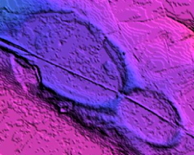
Gradualistic processes are considered by modern science to be responsible for the creation and evolution of the Carolina bay phenomenon. Given our LiDAR views of 45,000 bays perfectly formed and aligned landforms, that approach seems silly. A talk entitled “A Tale Of Two Craters: Coriolis-Aware Trajectory Analysis Correlates Two Pleistocene Impact Strewn Fields And Gives Michigan A Thumb” was presented at the GSA’s North-Central Section 2015 Meeting in Madison, WI. The abstract is linked above, and a PDF version of the talk is available from the GSA via the link HERE.
Pleistocene Epoch cosmic impacts have been implicated in the geomorphology of two enigmatic events. Remarkably, in both cases spirited debates remain unsettled after nearly 100 years of extensive research. Consensus opinion holds that the Australasian (AA) tektites are of terrestrial origin despite the failure to locate the putative crater, while a cosmic link to the Carolina bays is considered soundly falsified by the very same lack of a crater.
A high resolution image of Carolina bays was awarded first place in the GSA Annual Meeting 2010 Photo Contest & Exhibition. The entry is in the Abstract Images category (Depict patterns or form by way of photo-micrographs, satellite images, maps, or landscapes that capture a dynamic process or simply show the aesthetic patterns of geology at any scale.) See associated PAGE of imagery.
In recent years, two groups of scientists have attempted to resolve some aspects of the historical and geological record by leveraging cometary impacts.
The Holocene Impact Working Group has been researching on-shore geological structures which may have been created by large cometary impact-driven tsunamis. An interesting article describing their work is available at the New York Times.
There are two additional groups of individuals who are attempting to understand the foggy relationship between our cultural heritage and the physical manifestations of the earth's evolution using Science rather than Mythology. A primary goals of this treatise is to introduce the hypothesis to these groups, as they have demonstrated a tolerance for radical and unusually bizarre theories.
The Society of Interdisciplinary Studies
The Cambridge Conference newsletter, hosted by Dr. Benny Peiser.

Geological Research by Cintos is licensed under a Creative Commons Attribution-NonCommercial-ShareAlike 3.0 Unported License.
Based on a work at Cintos.org.
Permissions beyond the scope of this license may be available at http://cintos.org/about.html.